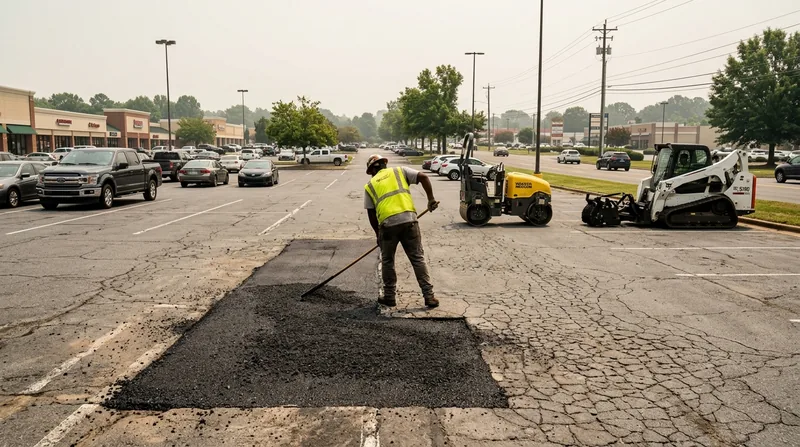




Charlotte's parking lots crack and pothole where clay subgrade shifts under repeated traffic and wet Piedmont seasons. The red clay that underlies Mecklenburg County and spreads across Gaston, Union, and Stanly counties swells when soaked and shrinks as it dries, breaking apart the asphalt above. Pothole repair and patching are urgent but temporary fixes. When cracks spread across thirty to forty percent of the surface, or when alligator cracking signals that the base has failed, parking lot repair and resurfacing becomes the only way to restore the lot to service. We cut out the failed section, rebuild the base with proper compaction, and patch it flush with hot mix asphalt so the lot holds through the next wet season. This page explains how the work is done, what drives the cost, and how to find the right contractor for your lot in Charlotte, Gastonia, Belmont, or the surrounding region.
Why Parking Lot Repair and Resurfacing Matters in Charlotte
A parking lot that fails does more than look neglected. Potholes and wide cracks catch water, which seeps into the base and accelerates deterioration. Uneven pavement creates trip hazards and liability exposure. A cracked lot signals to customers that the business is not maintained, and it invites further damage from traffic and freeze-thaw cycles. Charlotte's Piedmont clay, combined with heavy truck traffic and seasonal wet spells, makes parking lot failure inevitable without regular assessment and timely repair.
- We identify whether isolated potholes and cracks warrant patching or whether the lot needs full resurfacing.
- We remove failed asphalt and underlying base material, exposing the subgrade so we can assess and rebuild it.
- We compact the base to proper density, which stops the settlement and cracking that plague unrolled clay.
- We install new asphalt at the specified thickness, graded and crowned to shed water away from structures.
- We ensure the lot is smooth and level so vehicles do not bottom out and water does not pool.
A well-maintained parking lot protects your investment and keeps customers safe.
Key info: Charlotte and surrounding municipalities require permits for some parking lot work, particularly if the job involves curb cuts, stormwater drainage changes, or impervious surface limits. Check with your local building department before you begin. Mecklenburg County, Gaston County, and municipal jurisdictions like Charlotte, Gastonia, and Belmont each set their own rules. We help navigate the permitting process.
For more on the broader scope of lot paving and construction, see our parking lot paving and construction page.
How We Repair and Resurface Parking Lots in Charlotte
The approach depends on the extent of the failure. If the lot has a few isolated potholes and the surrounding asphalt is sound, we patch those areas. If thirty to forty percent or more of the surface shows alligator cracking or if the base has failed across a wide area, resurfacing or full-depth replacement becomes the best value. We measure the lot, assess the subgrade, and give you a written estimate that specifies the tonnage of asphalt, the depth, and the work scope so you know exactly what you are paying for.
- We saw-cut the perimeter of the failed area to create clean, straight edges that will bond with new asphalt.
- We remove the failed asphalt and any unstable base material using excavation equipment.
- We assess and prepare the subgrade, grading it so water runs away from the lot and compacting it to proper density.
- We lay a new base course if the subgrade requires additional support, then install the final wearing course of hot mix asphalt.
- We finish the patch flush with the surrounding pavement and grade it so water sheds toward the drainage system.
The result is a lot that is smooth, properly drained, and ready for traffic.
Example: A small retail lot in Matthews with three large potholes and minor surface cracks across about fifteen percent of the pavement typically requires targeted patching rather than full resurfacing. We cut out the failed areas, rebuild the base, and patch them flush. The cost is lower and the lot is restored. A larger lot in Gastonia with alligator cracking across forty percent of the surface signals that the base is moving and patching will fail quickly. That lot needs resurfacing or full-depth replacement to hold.
For details on our pothole repair and asphalt patching services, which are part of every parking lot job, see that page.
| Approach | Description | Best for |
|---|---|---|
| Pothole Patching | We cut out the failed area, prepare the base, and fill it with hot mix asphalt, compacting it flush with the surrounding pavement. | Isolated potholes and small cracks in otherwise sound lots. |
| Asphalt Resurfacing | We mill or remove the top layer of failed asphalt and install a new wearing course, typically 1.5 to 2 inches, over the existing base. | Lots with widespread surface cracking but a stable base, usually less than 30 percent failure. |
| Full-Depth Replacement | We remove all failed asphalt and base, rebuild the subgrade with proper compaction, install a new base course, and finish with a new wearing course. | Lots with alligator cracking, base failure, or extensive settlement across 40 percent or more of the surface. |
| Mill and Overlay | We mill off the top 1.5 to 2 inches of asphalt, which removes surface damage and creates a clean base for new asphalt, then install the overlay. | Lots where the base is sound but the surface is heavily cracked, and milled material can be recycled. |
Parking Lot Repair and Resurfacing Cost in Charlotte: What to Expect
Parking lot repair and resurfacing costs depend on the scope of failure, the size of the lot, the condition of the base, and the method chosen. Pothole patching starts at around $650 for a single area, but a lot with multiple failures or widespread cracking will cost significantly more. Resurfacing a small to medium lot (5,000 to 10,000 square feet) typically runs between $3,000 and $8,000, depending on whether the base is stable or requires rebuilding. Full-depth replacement is the most expensive option and is priced on site after we assess the subgrade and the scope of work. The single most important factor in your estimate is that it includes the tonnage of asphalt and the depth of the install, so you know what you are paying for.
Several factors move the cost up or down. A lot with a soft or unrolled subgrade requires more base preparation and compaction, which increases labor and material. A lot that has settled unevenly may need grading to restore proper slope for drainage. Access for equipment, the size of the failed area, and whether utilities are buried nearby all affect the price. A lot with significant alligator cracking across the base will require full-depth work, not resurfacing. The best way to understand the cost is to get a written estimate from us and from one or two other contractors so you can compare scope, tonnage, and pricing.
For a detailed pricing overview and what different service levels include, see our full pricing page.
What to Look for When Hiring a Parking Lot Contractor Near Charlotte
Hiring the right contractor is the difference between a lot that holds and one that fails again in two years. The paving trade has a long history of itinerant crews offering unsolicited deals on "leftover asphalt from a job nearby," demanding large cash deposits, and disappearing when the work fails. Legitimate contractors are verifiably local, provide written estimates that specify tonnage and thickness, and stand behind their work with a warranty on labor and materials. Before you hire, verify that any contractor you are considering is fully insured and check references from recent jobs in your area.
- Ask for a written estimate that specifies the tonnage of asphalt, the depth of the install, the method (patch, resurface, or full-depth), and the total cost.
- Verify that the contractor is fully insured and ask to see the certificate of insurance covering general liability and workers' compensation.
- Call or email at least two references from parking lot work completed in the past year in Charlotte or the surrounding area.
- Confirm that the contractor understands local permitting requirements and will help you navigate them if your lot requires a permit.
- Be cautious of estimates that are significantly lower than others, promises of a lifetime warranty, or requests for a large cash deposit before work begins.
- Verify that the contractor has a local address and local phone number, and that they are verifiably in business in Charlotte or the surrounding region.
We are fully insured and have been in business since 2015. Call us at (980) 890-6626 for a free, no-obligation estimate. We respond within 24 hours and provide written tonnage specifications so you know exactly what you are getting.
For more information and to request an estimate, visit our contact page.
Parking Lot Repair & Resurfacing in Charlotte: Pricing Guide
| Service | Price | Details |
|---|---|---|
| Pothole Patching | Starting at $650 | Single pothole cut, base prep, and hot mix patch, flush finish included, larger or multiple areas cost more |
| Asphalt Resurfacing | Starting at $3,000 | Small to medium lot, 5,000 to 10,000 square feet, stable base, new wearing course, grading and drainage included |
| Full-Depth Replacement | On estimate | Full removal, subgrade assessment and prep, base course, wearing course, and drainage work require site visit |
| Mill and Overlay | Starting at $2,500 | Milling removes top layer, new overlay installed, suitable for stable base with surface cracking only |
| Travel and Estimate | Free | No mileage charge in Charlotte and surrounding areas, free written estimate within 24 hours of your call |
Indicative pricing, the exact cost depends on square footage, finish, and site access. Free personalized estimate within 24h at (980) 890-6626.


