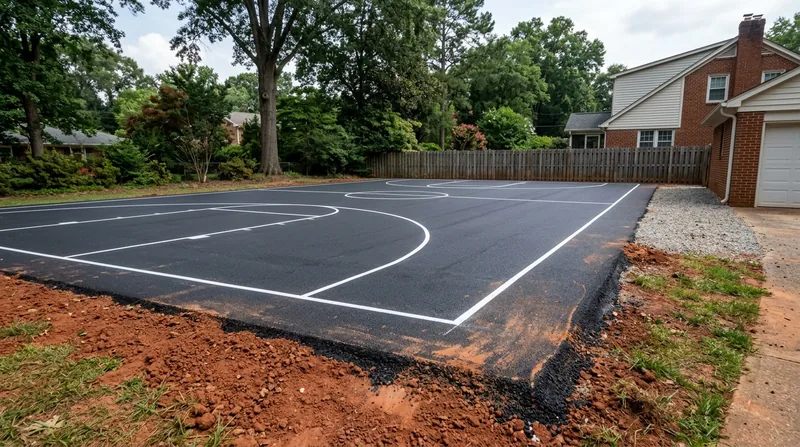




Sports Court & Path Paving in Charlotte requires a foundation built for the Piedmont's red clay and the humid summers that swell it. Charlotte's oldest neighborhoods, from NoDa to Dilworth, and the mill towns of Gaston County all sit on dense clay over saprolite that moves with every wet spell and dry period. A backyard court, tennis surface, or walking path needs a compacted base and proper drainage to stay flat and playable through the season. We grade and compact a stable base, then finish with hot mix asphalt so the court plays true through Charlotte's heavy storms and the moisture that comes with them. The work takes skill in reading the subgrade and the local water table, and it pays back in a surface that holds its line year after year.
Why Sports Court & Path Paving Matters in Charlotte: Drainage and Durability on Clay
Charlotte and the surrounding Piedmont region sit on red clay that swells when wet and shrinks as it dries. A court or path built on an unrolled or poorly compacted subgrade will crack, settle, and cup within a season or two, especially in the low spots where water pools after rain. The failure mode is always water. A properly built asphalt court starts with grading that sheds runoff away from the play surface and toward the street or a drainage swale. The base must be compacted to 95 percent of maximum density so it does not shift under the weight of a player or the freeze-thaw cycle in late winter. Hot mix asphalt, laid at the right thickness and temperature, bonds to that base and stays put.
- We proof-roll the subgrade to find soft spots before any asphalt goes down.
- We set proper crown and cross-slope so water runs off the court and does not stand on it.
- We compact base material in lifts so the foundation bears the weight of play without settling.
- We install hot mix at the thickness required for the court's intended use, typically 2 to 3 inches for a residential tennis or basketball surface.
- We finish the top course smooth so the ball rolls true and the player's footing is even.
A court built this way will hold its surface for ten to fifteen years with routine maintenance and no sealcoating. The difference between a court that fails in two years and one that plays flat for a decade is the base work that nobody sees.
Local example: A backyard court in Matthews or Mint Hill built on a soft subgrade without proof-rolling will show alligator cracking by the second or third spring after heavy rain cycles. The cost to replace it then is far higher than the cost to build it right the first time with a compacted base and proper drainage pitched away from the play surface.
For more on how we prepare bases for any paved surface, see our page on gravel driveway installation and grading, which covers the same compaction and proof-roll methods.
How We Build a Sports Court or Path in Charlotte: Step by Step
The work begins with a site visit to understand the slope, the subgrade, and where water will go. We mark out the court or path, then remove any soft material or debris down to firm ground. We bring in base material, typically crushed stone or recycled asphalt millings, and compact it in layers. Once the base is solid and properly crowned, we lay hot mix asphalt in one or two courses, depending on the thickness needed. The entire job, from grading to the final rolling, takes one to three days depending on the court size and weather.
- We measure the court and check the existing grade to understand drainage flow.
- We excavate soft subgrade material and haul it away, then inspect for roots or debris.
- We bring in compacted base material and roll it to 95 percent density in multiple lifts.
- We proof-roll the finished base to confirm it will not settle under load.
- We order hot mix asphalt to the thickness and binder grade required for the court's use.
- We lay and finish the asphalt while it is still hot, then roll it smooth and tight.
- We mark any lines or boundaries you request once the asphalt has cooled.
From start to finish, the focus is on the base. A court is only as good as what holds it up.
Charlotte example: A residential tennis court in Belmont or Harrisburg typically runs 2,500 to 3,500 square feet. With proper grading, compacted base, and 2.5 inches of hot mix, the job takes two days and costs between $8,500 and $12,000, depending on how much excavation and fill the existing grade requires. A walking path, smaller and simpler, might run $4,000 to $6,000 for 500 to 800 square feet.
For details on how we handle larger paved surfaces and base preparation, see our page on parking lot paving and construction.
Methods and Materials for Court and Path Paving
| Approach | Description | Best for |
|---|---|---|
| Hot mix asphalt, new court | 2 to 3 inches of compacted hot mix over a proof-rolled base of crushed stone or recycled asphalt. Laid and rolled while hot, finished smooth. | Residential tennis, basketball, or badminton courts where a flat, even surface is required and durability is the priority. |
| Recycled asphalt base, hot mix top | Crushed recycled asphalt millings as the compacted base layer, then 2 inches of hot mix on top. Reduces new material and cost. | Budget-conscious courts where existing site conditions allow recycled material, or where a lower-cost path is acceptable. |
| Walking or jogging path | 1.5 to 2 inches of hot mix over a 4 to 6 inch compacted stone base. Narrower, less load-bearing than a court. | Residential paths, garden walks, or access lanes where foot traffic is the primary load and cost is a factor. |
| Permeable or open-grade asphalt | Special mix design that allows water to drain through the asphalt into the base. Requires careful base preparation and is not suitable for heavy play. | Paths or courts where stormwater management is a municipal requirement and play is light or intermittent. |
Sports Court and Path Paving Cost in Charlotte: What to Expect
A residential tennis or basketball court in Charlotte typically starts at $8,500 for a basic installation on a site with good existing grade and no major excavation. The cost moves up with the size of the court, the amount of grading or fill required, and the distance from the street or the asphalt plant. A 3,000-square-foot court with minimal base work might run $9,000 to $11,000. A 4,000-square-foot court with significant excavation and fill could reach $13,000 to $16,000. A walking path, smaller and simpler, typically runs $4,000 to $6,000 for 500 to 800 square feet.
The factors that affect your final quote are straightforward. If the existing subgrade is soft or uneven, we will need to excavate and import compacted base material, which adds cost and time. If the site slopes heavily, we may need to cut and fill to achieve proper crown and drainage, again adding material and labor. If the site is far from our asphalt plant or difficult to access with our trucks, that adds delivery time. If you want special markings, boundaries, or a particular surface finish, we can do that too, and it shows up in the estimate.
The best way to understand the cost is to call for a free estimate. We measure the court, look at the grade and drainage, and give you a written quote with the thickness, tonnage, and labor spelled out. No surprises, no upsells.
For a full pricing overview across all our services, see our pricing page.
Sports Court and Path Paving Near Me: What Charlotte Homeowners Should Know When Hiring
Hiring a paving contractor for a backyard court is a straightforward process if you know what to look for. Start by getting estimates from at least two local companies. A real estimate includes a site visit, measurements, a written quote with the asphalt thickness and tonnage, and a clear timeline. Be wary of any contractor who quotes over the phone without seeing the site, or who offers a price that seems too good to be true. The classic paving scam is the unsolicited door-to-door pitch with leftover asphalt from a nearby job, a large cash deposit required upfront, and no written contract. That is not how legitimate local contractors work.
Ask each contractor about their base preparation method. Do they proof-roll the subgrade? Do they compact in lifts? How do they handle drainage? A contractor who can answer these questions clearly is one who understands the work. Ask for references, and call them. Ask how long the court has been down and how it is holding up. If the contractor has been in the Charlotte area for several years, they should have local references.
Check whether your city or HOA has rules about driveway materials or extensions. Some municipalities in Mecklenburg County and the surrounding area require permits for any new hardscape. Some HOAs restrict asphalt and require concrete or pavers. The contractor should be familiar with your local rules and help you navigate any permitting. We are fully insured, and we carry a workmanship warranty of one year on the installation. That is the honest standard in this trade.
If you have questions about our process or want to discuss your court or path project, contact us at (980) 890-6626 for a free estimate. We have been serving Charlotte and the surrounding area since 2015, and we know the local ground, the climate, and the drainage challenges that come with it.
Sports Court & Path Paving in Charlotte: Pricing Guide
| Service | Price | Details |
|---|---|---|
| Residential tennis or basketball court | Starting at $8,500 | Includes grading, compacted base, and 2.5 inches of hot mix asphalt on a site with minimal excavation |
| Court with significant grading or fill | Starting at $11,000 | Excavation, imported base material, and compaction add cost when existing grade requires major work |
| Walking or jogging path | Starting at $4,500 | Smaller footprint and lighter load allow lower thickness and less base material than a full court |
| Permeable or specialty surface | On estimate | Special mix designs and municipal stormwater requirements require site-specific engineering and material sourcing |
| Free estimate | No charge | Site visit, measurements, written quote with tonnage and thickness, response within 24 hours at (980) 890-6626 |
Indicative pricing, the exact cost depends on square footage, finish, and site access. Free personalized estimate within 24h at (980) 890-6626.


