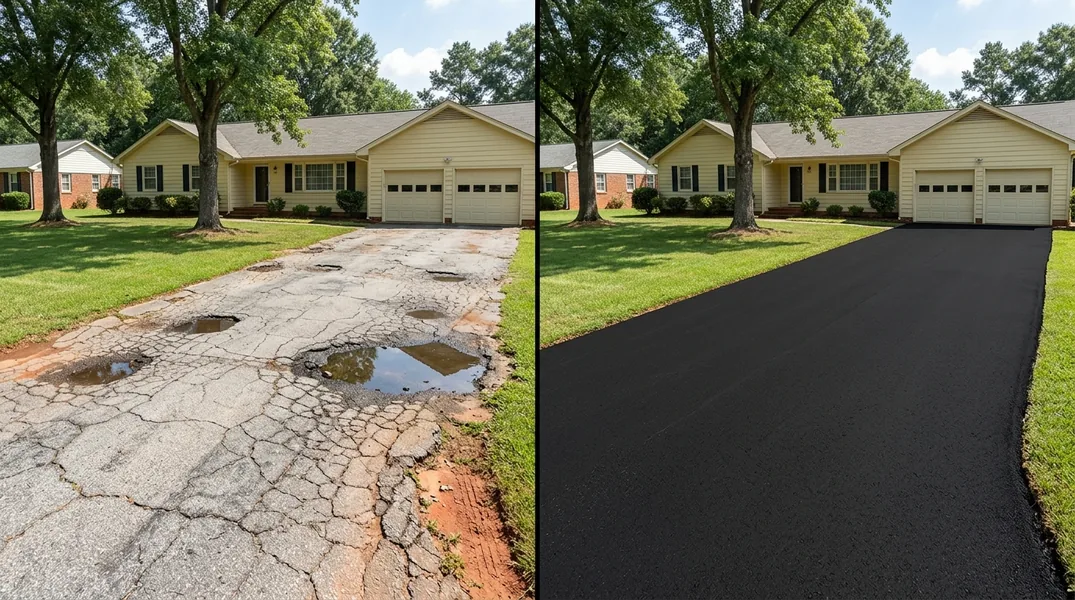
The Charm and Challenge of Charlotte's Post-War Ranch Driveways
Walk through any established neighborhood in Charlotte, and you'll spot them immediately: the classic post-war ranch homes that defined American residential architecture from the late 1940s through the 1960s. These modest, single-story dwellings with their pitched roofs, brick facades, and compact footprints remain beloved by homeowners for their timeless appeal and manageable maintenance. Yet beneath their nostalgic charm lies a persistent architectural quirk that troubles many owners today: the driveway.
Most post-war ranch homes were built with one-car driveways, often sloped at a steep pitch to accommodate the narrow lot widths common in that era. What seemed practical seventy years ago now presents modern challenges. The sloped, single-lane design creates poor drainage patterns, and the aging asphalt frequently develops cracks, potholes, and worst of all, pooling water that damages both the surface and the underlying foundation. If you own one of these characterful homes in Charlotte, understanding your driveway's drainage vulnerabilities is the first step toward protecting your investment.
Why Water Pooling on Driveways Is More Than a Cosmetic Problem
When you notice puddles lingering on your driveway hours after a rainstorm, it's easy to dismiss it as a minor inconvenience. In reality, water pooling on driveway surfaces is a red flag for structural failure. Standing water penetrates asphalt's porous surface, seeping into the base layers and subgrade beneath. This moisture weakens the compacted stone foundation, causing it to shift and settle unevenly. The freeze-thaw cycle common to Charlotte's winters accelerates this damage; water expands when frozen, creating pressure that fractures asphalt from within.
Beyond the driveway itself, pooling water threatens your home's foundation. Poor drainage channels water toward your house's perimeter, increasing the risk of basement leaks, foundation cracks, and costly water damage. Many homeowners don't connect their driveway's drainage problems to interior moisture issues until significant damage has already occurred. That's why addressing drainage early is not just about preserving asphalt; it's about protecting your entire property. The good news is that modern Asphalt Driveway Paving & Installation techniques incorporate proven drainage solutions that prevent these problems from developing.
Understanding Driveway Drainage Solutions: French Drains and Trench Systems
When it comes to fixing drainage issues, homeowners often hear terms like 'french drain driveway' and 'trench drain driveway' without fully understanding what these systems do or how they differ. A driveway french drain is a subsurface drainage system that redirects water away from your asphalt surface and foundation. It typically consists of a perforated pipe surrounded by gravel, installed beneath or alongside the driveway. Water naturally flows toward and through the perforated pipe, which channels it away from problem areas to a safe discharge point. This solution works particularly well for driveways with moderate drainage issues or where surface slope cannot be easily modified.
A trench drain driveway, by contrast, is a surface-level or near-surface drainage channel that captures water before it can pool. These systems feature a shallow, sloped trench with a grate or permeable cover, installed along the high side of your driveway or in low spots where water tends to collect. Trench drains are highly visible and effective for severe pooling problems, though some homeowners prefer the less obtrusive approach of a subsurface french drain. The best choice depends on your driveway's slope, soil composition, and the severity of your drainage issues. Charlotte Asphalt Paving can assess your specific situation and recommend the most effective driveway drainage solutions for your property.
Asphalt Driveway Paving & Installation Near Me: When to Call a Professional
If you're experiencing water pooling, visible cracks, or soft spots in your driveway, it's time to stop guessing and get professional eyes on the problem. Many homeowners attempt DIY fixes like filling cracks with sealant or applying surface coatings, only to discover these are temporary band-aids that don't address the underlying drainage failure. A qualified asphalt contractor will evaluate your driveway's slope, inspect the base layers, and determine whether your issues stem from poor initial installation, settling, or simply age-related wear.
For post-war ranch homes with their characteristically steep one-car pitches, professional Asphalt Driveway Paving & Installation might involve more than just repaving. It could include regrading to improve slope, installing subsurface drainage, or even widening the driveway to modern two-car standards if your property permits. These are complex decisions that benefit from expert assessment. Charlotte Asphalt Paving serves homeowners throughout the region and can provide a thorough evaluation and free estimate tailored to your home's unique needs. Don't wait until minor drainage issues become major foundation problems; reach out at (980) 890-6626 to schedule your assessment today.
Repair Versus Replacement: When Your Driveway Needs More Than Patching
A common question homeowners ask is whether their aging driveway can be salvaged through Driveway Repair or Pothole Repair & Asphalt Patching, or if full replacement is necessary. The answer hinges on several factors: the extent of cracking, the condition of the base layers, and whether drainage problems have already compromised the foundation. If your driveway has only surface-level cracks and minor potholes, targeted repairs may extend its life by several years. However, if pooling water is present, the base has begun to fail, or cracks are widespread and interconnected, patching is merely delaying the inevitable.
In these cases, Asphalt Resurfacing & Overlay or full replacement becomes the more cost-effective long-term solution. A complete reconstruction allows you to address drainage deficiencies from the ground up, installing proper french drain systems or trench drains, improving slope for better water runoff, and using modern asphalt mixes designed for durability. While the upfront investment is higher than patching, you gain a driveway that will perform reliably for 15 to 20 years rather than one that requires constant maintenance. Charlotte Asphalt Paving can help you understand which approach makes sense for your specific situation.
Asphalt Driveway Paving & Installation Cost in Charlotte: What to Budget
Homeowners naturally want to know what they'll pay for driveway work. The pricing for Asphalt Driveway Paving & Installation varies widely depending on driveway size, existing condition, and the complexity of drainage solutions required. A simple resurface of a small, single-car driveway might cost less than a full reconstruction with french drain installation. Adding drainage infrastructure, whether subsurface french drains or surface trench systems, increases the project cost but delivers long-term value by preventing expensive water damage to your home's foundation.
Rather than guessing at costs, the most reliable approach is to request a detailed free estimate from Charlotte Asphalt Paving. Our team will evaluate your driveway's condition, discuss drainage concerns, and provide transparent pricing for the recommended solution. We serve homeowners throughout Charlotte and surrounding areas, and we're happy to answer your questions about what your specific project will cost. Call us at (980) 890-6626 or visit our website to schedule your consultation. Investing in proper drainage solutions now will save you thousands in foundation repairs later.
Looking for a professional asphalt paving contractor in Charlotte? Charlotte Asphalt Paving responds fast for all your asphalt paving needs.
Get a Free Quote