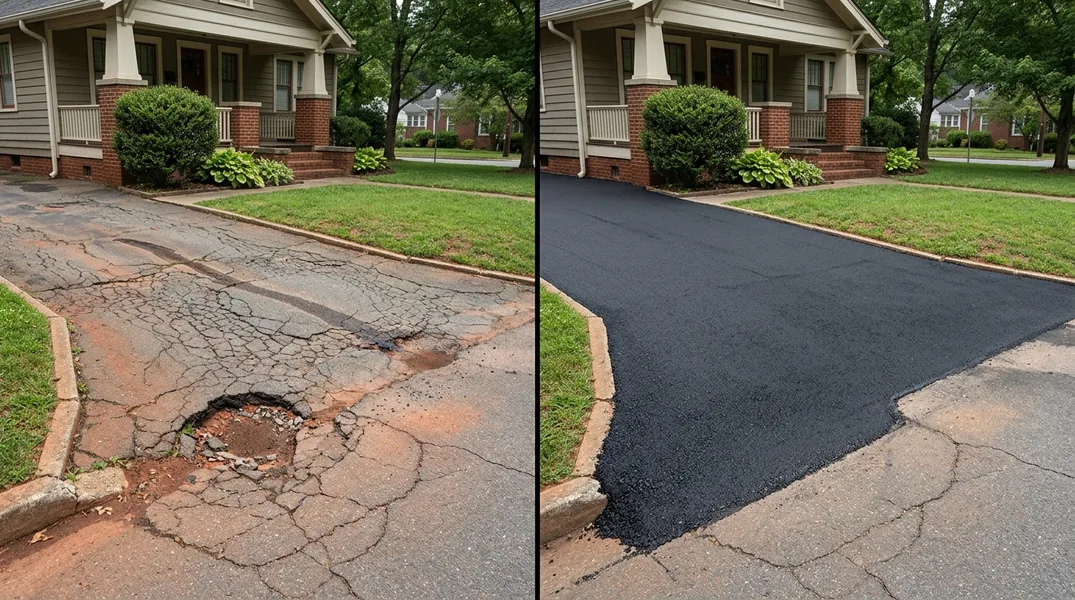
The Millings Driveway Problem in Union and Stanly County Subdivisions
If you own a home in a Union or Stanly County subdivision, you've likely noticed a troubling pattern: driveways made from asphalt millings deteriorate far faster than traditional asphalt surfaces. This isn't a coincidence. Homeowners across the region are discovering that what seemed like a budget-friendly alternative at purchase time becomes an expensive headache within just a few years. The problem is so widespread that entire subdivisions are now facing the same costly repairs simultaneously, creating a perfect storm of property maintenance challenges.
Asphalt millings, also called recycled asphalt driveway material, are the crushed remnants from old asphalt surfaces. While recycling sounds environmentally responsible and the initial millings driveway cost is significantly lower than new asphalt, the material lacks the binding agents and structural integrity of properly installed asphalt. When thousands of homes in the same subdivision all have millings driveways, they all fail on roughly the same timeline, leaving homeowners scrambling for solutions and contractors overwhelmed with demand.
Why Crushed Asphalt Millings Don't Hold Up Over Time
Understanding why crushed asphalt driveway material fails requires looking at what makes it different from traditional asphalt. New asphalt is a carefully engineered mixture of aggregate (crushed stone), sand, and liquid asphalt cement that binds everything together. This cement creates a cohesive surface that flexes slightly with temperature changes and resists water penetration. Recycled asphalt millings, by contrast, are simply old asphalt chunks that have been broken up. While they may contain some residual binder, there's no fresh asphalt cement to hold the particles together as a unified surface.
When millings are spread on a driveway base, they compact initially under vehicle weight, creating a temporary driving surface. However, without adequate binding, the individual particles begin to separate almost immediately. Rain seeps between the loose pieces, freeze-thaw cycles in the Charlotte area cause expansion and contraction, and vehicle tires constantly displace material. Within one to three years, homeowners notice ruts forming, material migrating to the edges of the driveway, and a surface that's more like gravel than asphalt. This is precisely why entire subdivisions in Union and Stanly County are experiencing synchronized failures.
The Subdivision-Wide Failure Pattern Explained
Developers in Union and Stanly County subdivisions often chose millings driveways as a cost-cutting measure during the initial construction phase. By using recycled material instead of installing proper asphalt, they reduced upfront costs significantly, making homes more affordable at sale. However, they transferred the maintenance burden to homeowners. When fifty, one hundred, or even five hundred homes in a subdivision all receive the same millings driveway treatment, they all begin failing within the same window of time. This creates a unique problem: simultaneous demand for Driveway Repair services across an entire community.
The cascading effect is real and documented. Homeowners start noticing deterioration and reach out to contractors. Contractors become booked for months. Material and labor costs can increase due to high demand. Worse, some homeowners delay repairs hoping costs will drop, but instead the damage compounds. A driveway that could have been repaired with Pothole Repair & Asphalt Patching becomes so damaged that it requires complete replacement with proper Asphalt Driveway Paving & Installation. This synchronized failure pattern is one of the most frustrating aspects of living in a subdivision built with millings driveways.
Asphalt Millings Driveway Cost vs. Long-Term Value
The initial appeal of millings driveways is straightforward: the upfront millings driveway cost is dramatically lower than new asphalt installation. A homeowner might save $2,000 to $5,000 on initial driveway construction by choosing millings over traditional asphalt. For a developer building dozens of homes, this adds up to substantial savings that can be passed along to buyers or kept as profit. However, this short-term thinking creates long-term financial pain for homeowners.
When you factor in the true cost of ownership over ten years, millings driveways become far more expensive than traditional asphalt. A properly installed asphalt driveway typically lasts 15 to 20 years with basic maintenance. A millings driveway rarely lasts more than three to five years before requiring significant repair or replacement. This means a homeowner with a millings driveway might spend $3,000 replacing it after five years, then another $5,000 to $8,000 for a proper asphalt installation that will last another 15 years. Compare this to a homeowner who invested $7,000 to $10,000 in quality asphalt from the start and enjoys a 20-year lifespan. The math clearly favors proper asphalt. To understand what you should budget for a quality solution, we encourage you to request a free estimate from Charlotte Asphalt Paving at (980) 890-6626.
The Solution: Professional Asphalt Driveway Paving and Installation Near Me
If your driveway is made of asphalt millings and showing signs of failure, the solution is clear: replace it with properly installed asphalt. This isn't a DIY project or a quick fix with more millings. Professional Asphalt Driveway Paving & Installation involves site preparation, proper base compaction, quality asphalt mix, and professional installation techniques that ensure longevity. The difference between a millings surface and professional asphalt is the difference between a temporary patch and a real solution.
For homeowners in Union and Stanly County subdivisions, finding a local contractor who understands the specific challenges of your area is essential. Charlotte Asphalt Paving serves the greater Charlotte region and has extensive experience with subdivision driveway projects. A professional contractor will assess your current driveway condition, recommend whether repairs or replacement is more cost-effective, and provide a transparent estimate. If your driveway has deteriorated beyond repair, Asphalt Resurfacing & Overlay or complete replacement ensures you get a surface built to last.
Taking Action: Don't Wait for Your Subdivision's Failure Wave
The key lesson from Union and Stanly County subdivisions is this: don't wait for your millings driveway to fail completely before taking action. Early intervention is far more cost-effective than waiting until the damage is severe. If you notice ruts, loose material, or a gravel-like texture on your driveway, these are warning signs that professional assessment is needed. The longer you delay, the more likely the underlying base becomes compromised, which increases repair costs exponentially.
Homeowners who act proactively by addressing millings driveway issues early often find that recycled asphalt driveway damage can sometimes be managed with targeted repairs before full replacement becomes necessary. However, once the foundation deteriorates, replacement is the only lasting solution. Charlotte Asphalt Paving is ready to help you avoid the mistakes made in other subdivisions. Contact us today at (980) 890-6626 or visit our website to discuss your driveway situation and learn what a proper asphalt surface can do for your home's curb appeal and property value. Don't let your driveway become another casualty of the subdivision-wide millings failure pattern.
Looking for a professional asphalt paving contractor in Charlotte? Charlotte Asphalt Paving responds fast for all your asphalt paving needs.
Get a Free Quote